
Your real estate contract isn’t just a stack of paperwork designed to protect a broker; it’s a high-stakes strategic roadmap where a single missed checkbox can cost you tens of thousands of dollars in earnest money. With the median home price in Los Angeles County reaching $828,300 in 2026, the margin for error has never been thinner. Mastering the art of understanding California real estate contracts is no longer a luxury for the well-informed; it’s a fundamental necessity for any buyer or seller who values their financial security, their peace of mind, and their future.
I understand that the dense legal parlance and strict timelines of the California Residential Purchase Agreement can feel daunting, especially when you’re facing the pressure of a 3.4-month inventory shortage. You want to move quickly, yet you fear that a hidden disclosure or a misunderstood contingency might lead to a costly mistake. This guide provides the clarity, precision, and legal fluency you need to sign the RPA with absolute confidence. We’ll examine the strategic use of contingencies, the impact of new 2026 laws like AB 2992, and the critical disclosures regarding everything from AI-altered images to future gas appliance regulations.
Key Takeaways
- Define the legal pillars of a “meeting of the minds” to ensure your agreement is built on clarity, security, and mutual consent.
- Navigate the financial architecture of your journey by understanding California real estate contracts and the strategic management of deposits and escrow timelines.
- Learn to utilize contingencies as protective shields while mastering the distinction between “as-is” purchases and the seller’s mandatory disclosure requirements.
- Master the active contingency removal process and the “Notice to Perform” to maintain a steady, predictable rhythm throughout the performance phase.
- Leverage the precision and legal fluency of an expert advisor to turn complex contract clauses into a strategic advantage during competitive negotiations.
The Anatomy of a California Real Estate Contract: More Than Just Signatures
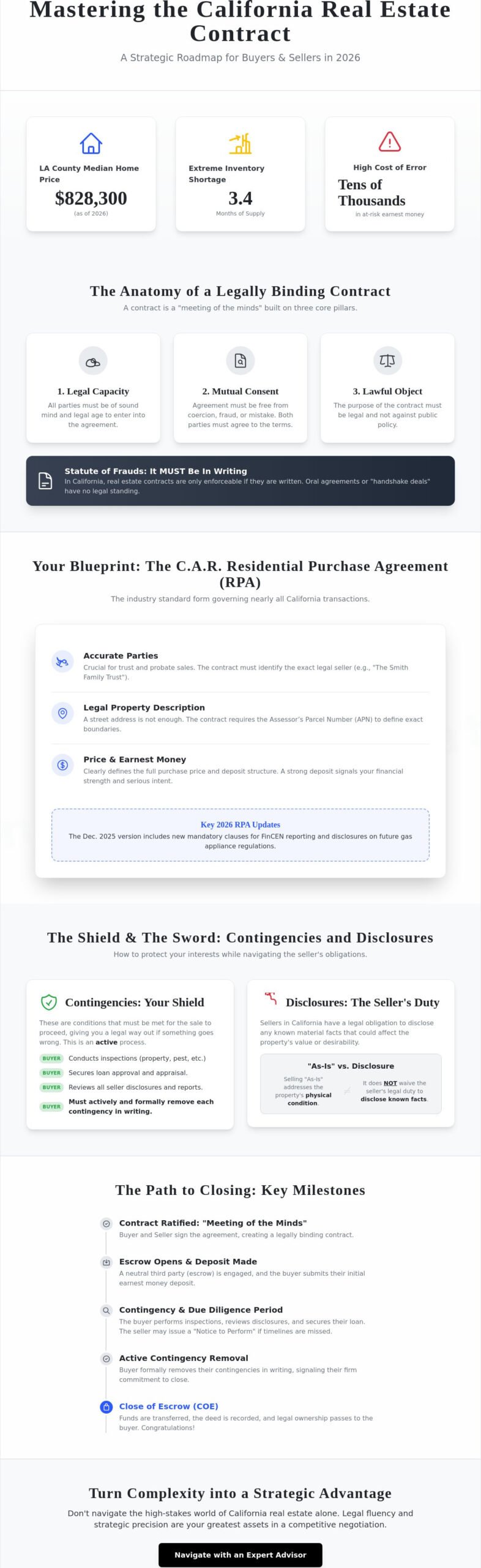
A contract is far more than a collection of terms printed on a page; it is a legally binding “meeting of the minds” between a buyer and a seller. This psychological and legal alignment ensures that both parties share a singular vision for the transaction, providing a framework of clarity, security, and professional peace of mind. When you begin the process of understanding California real estate contracts, you must view the document as a strategic roadmap that governs the transition of a significant asset. For a contract to hold weight in a California court, it must possess three core pillars: legal capacity, mutual consent, and a lawful object. The parties must be of sound mind and legal age, they must agree to the terms without coercion, and the purpose of the agreement must comply with all state and federal laws.
One of the most critical legal concepts you will encounter is “consideration.” In the fast paced Southern California market, consideration is the exchange of value that makes the contract biding. Usually, this takes the form of the purchase price offered by the buyer in exchange for the title to the property. Because real estate involves such high stakes, California enforces the Statute of Frauds. This legal principle dictates that any real estate contract must be in writing to be enforceable. Oral promises or “handshake deals” carry no weight in the eyes of the law, which is why every detail must be meticulously documented to protect your interests as a buyer or seller.
The Role of the C.A.R. Residential Purchase Agreement (RPA)
The California Association of Realtors (C.A.R.) provides the standard forms used in nearly every transaction across the state. These forms are the industry standard because they are vetted by legal experts to ensure maximum transparency and compliance with evolving legislation. The December 2025 version of the RPA, which governs transactions in 2026, incorporates essential updates regarding FinCEN reporting and gas appliance disclosures. While these forms are “standard,” you should never treat them as static templates. Every checkbox, date, and dollar amount represents a point of strategic negotiation where precision and legal fluency can provide a distinct advantage in a multiple offer scenario.
Essential Elements Every Contract Must Include
A valid contract begins with the accurate identification of the parties. This is particularly sensitive in trust and probate sales where the seller is often a trustee or an estate representative rather than an individual. Beyond names, the property itself must be clearly defined. In Los Angeles County, relying on a simple street address is insufficient; the contract must include the legal property description or the Assessor’s Parcel Number (APN) to ensure the exact boundaries of the land are accounted for. Finally, the purchase price and the nuances of the “earnest money” deposit must be clearly stated. In our current competitive climate, a well structured deposit signals your financial strength and your serious intent to perform on the contract.
Navigating the Strategic Roadmap: Key Financial and Operational Terms
Moving from the theoretical “meeting of the minds” to the practical execution of a transaction requires a deep grasp of the financial stack. This stack is not a single number but a layered sequence involving the initial earnest money deposit, any subsequent increased deposits, and the final loan balance. In a competitive environment where the median home price in Los Angeles County sits at $828,300, these figures represent your commitment, your liquidity, and your financial strength. Mastering the nuances of understanding California real estate contracts means recognizing that the “Close of Escrow” (COE) is not just a date on a calendar. It’s the definitive finish line where legal title transfers, funds disperse, and your journey as a homeowner begins.
While the purchase price often dominates the conversation, the true complexity of the transaction lies in the allocation of costs and the timing of possession. These terms dictate who bears the burden of title insurance, escrow fees, and local transfer taxes. If you don’t account for these with precision, you may find yourself facing unexpected five-figure expenses at the eleventh hour. Furthermore, possession clauses require a delicate touch, particularly when using a Seller-in-Possession (SIP) agreement. These arrangements allow a seller to remain in the property after closing, but they introduce unique risks regarding liability and property condition that demand the oversight of a protective expert. For those preparing to sell, a comprehensive market analysis can help clarify how these financial terms might influence your net proceeds.
Financing Terms and Appraisal Gaps
It’s vital to distinguish between a loan contingency, which protects you if your financing fails, and an appraisal contingency, which protects you if the property’s value comes in low. An Appraisal Gap is a contractual commitment where the buyer agrees to cover the difference in cash if the lender’s appraisal falls short of the purchase price. With 30-year fixed mortgage rates averaging 6.50% in May 2026, many buyers utilize “All Cash” offers to bypass these hurdles, though these still require a rigorous proof of funds to satisfy the seller’s fiduciary expectations.
Allocating Costs: The Local Customs of Southern California
The “Allocation of Costs” section is where localized expertise becomes indispensable. In Burbank, it’s customary for the seller to pay for the owner’s title insurance policy and the county transfer tax, whereas in Pasadena, these costs are frequently split or negotiated differently. These customs are rooted in decades of practice and are often influenced by the California Real Estate Law standards that govern disclosure and fair dealing. Beyond title fees, you must account for city-mandated inspections or retrofitting requirements, such as water heater bracing or smoke detector compliance, which vary significantly between Glendale and Los Angeles. A methodical approach to these details ensures a smooth process, providing you with stability, wisdom, and foresight during the buying or selling journey.
The Shield and the Sword: Understanding Contingencies and Disclosures
In the high-stakes environment of 2026, where only 18% of California households can afford a median-priced home, the contract serves as your primary defense. Contingencies act as the “shield,” serving as vital escape hatches that allow you to cancel a transaction without the loss of your earnest money deposit. Conversely, disclosures are the “sword,” cutting through ambiguity to reveal the true state of a property. Mastery of understanding California real estate contracts requires you to recognize that these clauses are not obstacles; they are the mechanisms that ensure a secure, transparent, and ethical transition of ownership. This balance of protection and revelation creates an environment of rigor, ethics, and strategic foresight.
When you approach the task of understanding California real estate contracts, you must view the “As-Is” clause through a clinical lens. Many buyers feel anxious when they see this box checked, fearing they have waived their right to a quality home. It’s vital to understand that an “As-Is” sale in California does not waive the buyer’s right to investigate the property, nor does it absolve the seller of their fiduciary duty to disclose known material defects. It simply means the seller is not contractually obligated to perform repairs. To truly protect yourself in a real estate transaction, you must leverage the investigation period to uncover the property’s hidden narrative before you commit your capital.
The Three Pillars: Inspection, Appraisal, and Loan
The “Investigation of Property” period is your most powerful tool for due diligence. It shouldn’t just cover the roof and foundation; it must extend to specialized inspections for sewer lines, chimney integrity, and geological stability. The appraisal contingency acts as a financial safeguard, ensuring your down payment isn’t eroded by a valuation that fails to meet the purchase price. Finally, the loan contingency serves as the ultimate hurdle, providing a safety net until your lender issues a formal, firm commitment. These three pillars provide a foundation of compassion, precision, and deep legal fluency for every buyer.
Seller Disclosures and the Duty of Transparency
California law mandates a high level of transparency through the Transfer Disclosure Statement (TDS) and the Seller Property Questionnaire (SPQ). These documents are legal shields for the seller, documenting known issues to prevent future litigation. In areas like the Hollywood Hills, the Natural Hazard Disclosure (NHD) is particularly critical, as it identifies risks related to fire zones, seismic activity, and flood plains. Starting in 2026, this transparency extends to tobacco residue and future gas appliance regulations. Failing to disclose a material fact is not just a breach of contract; it’s a legal liability that can lead to severe financial consequences long after the keys have changed hands.
The Performance Phase: Contingency Removal and the Path to Closing
The transition from a signed agreement to the final transfer of title is a period defined by meticulous execution and rhythmic progress. In California, we utilize an “Active Removal” system, which is a critical distinction for anyone understanding California real estate contracts. Unlike many other states where contingencies simply expire after a set period, California requires the buyer to physically sign a Contingency Removal (CR) form to waive their protections. This system ensures that no legal right is surrendered by accident, but it also places a significant burden of precision on the buyer to meet their contractual obligations. If you fail to remove a contingency on time, the seller may issue a “Notice to Perform,” a formal document that provides a 48-hour window to act or face potential cancellation of the entire transaction.
The stakes of this phase are best illustrated by the Liquidated Damages clause. Once you remove all contingencies, your earnest money deposit is no longer protected by the “escape hatches” discussed earlier in this guide. If a buyer defaults after this point, the seller typically retains the deposit as liquidated damages, which is contractually capped at 3% of the purchase price. With the statewide median price projected at $905,000 for 2026, this represents a potential loss of $27,150. This is why having a wise counselor to navigate these deadlines with stability and wisdom is not just helpful; it’s a financial necessity. For personalized guidance through these complex performance stages, you can explore my Buyer Representation Services to ensure every deadline is met with clinical accuracy.
The Step-by-Step Timeline of Contingency Removal
Navigating the path to closing requires a methodical approach to four distinct milestones. First, you must complete the inspection period, which involves reviewing disclosures and requesting any necessary repairs or credits from the seller. Second, once you receive the appraisal report and confirm the value meets the lender’s requirements, you clear the appraisal contingency. Third, after receiving final loan approval from your underwriter, you remove all remaining contingencies, effectively making the contract “firm.” Finally, you perform the “Verification of Property,” or final walkthrough, typically five days before closing to ensure the home remains in the agreed-upon condition.
What Happens When a Party Fails to Perform?
When a party fails to meet a deadline, the “Notice to Buyer to Perform” (NTP) acts as a tool of clarity and decisiveness. This document gives the buyer a typical 48-hour window to fulfill their obligation. If the buyer still fails to perform, the seller gains the right to cancel the contract and potentially seek a new offer. Conversely, if a seller fails to perform their duties, a buyer may seek “Specific Performance,” a legal remedy that asks a court to compel the seller to complete the sale as promised. Most disputes are first addressed through mediation and arbitration, which are established in the contract to provide a path to resolution that avoids the aggression and expense of a full-scale trial.
The Strategic Advantage: Why Legal Fluency Matters in Negotiation
Legal fluency isn’t just a professional credential; it’s a strategic weapon in a multiple offer scenario. When you’re competing against ten other buyers for a property in the Burbank Rancho, the seller isn’t just looking at the purchase price. They’re looking for the offer with the fewest friction points and the highest probability of closing. My background as a former attorney allows me to approach understanding California real estate contracts with a level of intellectual rigor that most agents simply can’t match. This perspective ensures that every clause is drafted with precision, every contingency is leveraged strategically, and every risk is mitigated before it becomes a liability. Trusted Advisor. Experienced Negotiator. Caring Fiduciary. These aren’t just titles; they represent a methodical approach to communication that prioritizes your security above all else.
Understanding California real estate contracts is more than a technical skill; it is a competitive edge that provides stability and wisdom during a high stakes journey. Real estate is rarely just a financial transaction; it’s an emotional transition that requires a steady and considered advisory style. By utilizing a resourceful partnership that blends high level professional designations with localized expertise, you gain the confidence to navigate complex legal hurdles. This “Wise Counselor” approach ensures that you’re never pressured into a decision, but rather empowered with the deep legal fluency required to make the choice that best serves your long term goals.
Protecting Fiduciary Interests in Trust and Probate Sales
The standard RPA takes on a new layer of complexity when a transaction involves the California probate code real estate. For executors and trustees, the burden of disclosure is balanced by specific statutory exemptions, yet the fiduciary responsibility to the estate remains absolute. Navigating these waters requires more than just a real estate license; it demands a probate real estate agent Los Angeles who understands how to protect the estate’s interests while ensuring a smooth transition for the buyer. These sales are often sensitive matters for families, requiring a protective expert who can manage the technical requirements with compassion, patience, and professional authority.
Your Realtor. Your Choice.
The journey of understanding California real estate contracts eventually leads to a single realization: your agent is your most critical strategic partner. When choosing a Los Angeles real estate agent, you deserve a representative who values your autonomy and provides the clarity needed to make informed choices. This process shouldn’t feel rushed or aggressive; it should feel like a deliberate conversation where every point is given its due weight. If you’re ready to move forward with a partner who offers a sophisticated blend of legal fluency and empathetic guidance, contact Will Flannigan for a strategic consultation. Your goals, your security, and your choice remain the steady heartbeat of everything we do.
Empowering Your Journey with Strategic Clarity
Securing your financial future in the California market requires more than a simple signature; it demands a commitment to clarity and professional oversight. You’ve seen how the California Residential Purchase Agreement acts as a complex roadmap. It’s a document that requires meticulous attention to deadlines, active contingency removal, and a clear grasp of statutory disclosures. By prioritizing a deep understanding California real estate contracts, you transform a daunting legal process into a predictable path toward homeownership. This journey is best managed with a partner who offers the weight of professional authority and the warmth of community roots.
As a former attorney and Certified Negotiation Expert (CNE), I provide my clients with the precision and deep legal fluency required to manage the 2026 market. As a specialist in trust and probate sales, I understand that real estate is not just a financial transaction but an emotional transition that demands a steady, considered hand. Your home is more than a financial asset; it’s the foundation of your future. Navigate your next move with strategic precision; contact Will Flannigan today. I look forward to helping you move forward with confidence, security, and peace of mind.
Frequently Asked Questions
Is a California real estate contract legally binding?
Yes, a California real estate contract is a legally binding agreement once it is signed by both the buyer and the seller and that acceptance has been communicated. This “meeting of the minds” creates a framework of mutual obligations that is enforceable under the Statute of Frauds. It requires legal capacity, mutual consent, and a lawful object to remain valid and enforceable in the eyes of the law.
Can a buyer back out of a real estate contract in California?
A buyer can typically back out of a contract without penalty if they have active contingencies in place. These protective “escape hatches” allow for a cancellation based on unsatisfactory inspection results, a low appraisal, or a failure to secure financing. Once these contingencies are formally removed, backing out usually results in the loss of the earnest money deposit under the liquidated damages clause.
What is the “Active Contingency Removal” process?
The “Active Contingency Removal” process is a unique California system where contingencies do not simply expire with the passage of time. Instead, the buyer must physically sign a Contingency Removal (CR) form to waive their protections. This methodical approach ensures transparency, protects the buyer’s deposit, and provides a clear signal that the transaction is moving toward a firm and binding commitment.
What happens if a seller lies on the Transfer Disclosure Statement (TDS)?
If a seller intentionally misrepresents property conditions on the Transfer Disclosure Statement, they may be held liable for fraud or breach of contract. Buyers who discover undisclosed material defects after closing can seek damages through mediation, arbitration, or litigation. This is why understanding California real estate contracts and the seller’s fiduciary duty of honesty is vital for your long term financial security.
How long is the standard contingency period in California?
The standard default periods in the C.A.R. Residential Purchase Agreement are 17 days for inspections and appraisals, and 21 days for loan approval. However, these timelines are frequently negotiated and shortened in competitive Southern California neighborhoods to make an offer more attractive to a seller. Every deadline represents a strategic milestone that requires precision, foresight, and clinical accuracy to manage successfully during the journey.
Does a “Notice to Perform” mean the deal is over?
A “Notice to Perform” does not mean the transaction is over; it is a formal demand for action. It typically gives the receiving party a 48-hour window to fulfill a specific contractual obligation, such as removing a contingency or providing a required disclosure. It serves as a tool for clarity and decisiveness, keeping the process moving toward a smooth and predictable close of escrow.
What is the difference between a trust sale and a traditional sale contract?
Trust sales differ from traditional sales primarily in the level of mandatory disclosures required of the seller. While a traditional seller must provide a TDS and SPQ, a trustee who has never lived in the property is often exempt from these specific forms under the California probate code. However, the trustee still maintains a duty to disclose any known material facts that could affect the property’s value or desirability.
How does Proposition 19 affect property tax transfers in Los Angeles?
Proposition 19 allows eligible homeowners in Los Angeles to transfer their original property tax base to a new primary residence anywhere in California. This benefit applies to those over 55, individuals with disabilities, or victims of natural disasters. Understanding California real estate contracts in this context is essential, as it helps buyers maintain the stability and financial predictability established by their original Proposition 13 assessment.